
The new year ushers in a fresh round of 2025 tax updates, as the IRS adjusts key provisions to reflect inflation. These annual changes aim to preserve the value of your tax benefits and help you keep pace with rising costs. By staying on top of these updates, you’ll be in a better position to refine your financial plans, optimize your tax strategies, and seize new opportunities to maximize your retirement savings.
Table of Contents
How the IRS Calculates Annual Tax Adjustments
Each year, the IRS revises tax provisions to account for inflation, ensuring the tax system remains fair and responsive to economic changes. Before 2018, these adjustments relied on the Consumer Price Index for Urban Consumers (CPI-U), a widely used measure of inflation.
However, the Tax Cuts and Jobs Act of 2017 introduced a new standard: the Chained Consumer Price Index (C-CPI). Unlike the traditional CPI-U, the C-CPI factors in changes in consumer behavior, such as choosing more affordable alternatives when prices rise. As a result, the C-CPI tends to produce smaller adjustments to tax brackets, deductions, and other parameters.
These annual updates are indeed essential in preventing “bracket creep,” where inflation pushes income into higher tax brackets without increasing purchasing power. By aligning tax thresholds, deductions, and credits with economic realities, the IRS helps ensure taxpayers can maintain the value of their benefits and avoid unintended tax burdens.
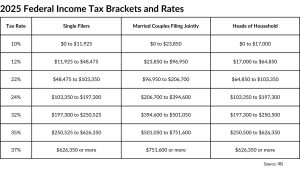
2025 Federal Income Tax Brackets and Rates
The federal income tax system for 2025 retains its seven-tier structure, with rates set at 10%, 12%, 22%, 24%, 32%, 35%, and 37%. Furthermore, the top marginal tax rate of 37% applies to taxable income exceeding $626,350 for single filers and $751,600 for married couples filing jointly.
2025 Standard Deduction Amounts
The 2025 tax updates deliver higher standard deduction amounts, giving taxpayers more ways to reduce their taxable income. Single filers will see their standard deduction increase to $15,000, while married couples filing jointly can claim $30,000. Additionally, heads of household will benefit from an increased deduction of $22,500.
Seniors aged 65 and older will also enjoy additional tax savings. Specifically, single filers in this age group can claim an extra $2,000, and married couples filing jointly are eligible for an additional $1,600 per qualifying spouse.
Alternative Minimum Tax (AMT) Updates for 2025
The Alternative Minimum Tax (AMT), introduced in the 1960s, was designed to ensure high-income taxpayers contribute a minimum level of federal income tax, even after utilizing deductions and credits. By targeting aggressive tax avoidance strategies, the AMT primarily impacts higher earners while generally sparing middle-income taxpayers.
Here are the key AMT updates for 2025:
- Exemption Amounts. Single filers can claim an AMT exemption of $88,100, while married couples filing jointly are eligible for $137,000.
- 28% Rate Threshold. The higher AMT rate of 28% applies to Alternative Minimum Taxable Income (AMTI) exceeding $239,100 for all taxpayers, or $119,550 for married couples filing separately.
- Exemption Phaseouts. The AMT exemption begins to phase out at AMTI levels above $626,350 for single filers and $1,252,700 for married couples filing jointly.
Child Tax Credit Updates for 2025
The maximum Child Tax Credit for 2025 remains steady at $2,000 per qualifying child, as it is not subject to annual inflation adjustments. However, the refundable portion of the credit—allowing eligible taxpayers to receive a refund even if they owe no federal income tax—has been increased for inflation, rising to $1,700 for the year.
2025 Capital Gains Tax Brackets
In 2025, the federal capital gains tax rates remain aligned with income thresholds:
- 0% Rate: Taxpayers with total taxable income of $48,350 or less owe no federal capital gains tax.
- 15% Rate: For taxable income between $48,351 and $533,400, long-term capital gains are taxed at 15%.
- 20% Rate: Taxpayers with income exceeding $533,400 are subject to the top capital gains tax rate of 20%.
These brackets apply to long-term capital gains, which are profits from the sale of assets held for more than one year.
Qualified Business Income (QBI) Deduction for 2025
The Qualified Business Income (QBI) deduction, established by the Tax Cuts and Jobs Act of 2017, offers eligible pass-through business owners a significant tax break by allowing them to deduct up to 20% of their qualified business income.
Here’s what to know for the 2025 tax year:
- Phaseout Thresholds. The QBI deduction begins to phase out at $197,300 for individual filers and $394,600 for married couples filing jointly.
- Impact of Higher Incomes. Taxpayers with income exceeding these thresholds may see their deduction reduced or eliminated, depending on factors like their business type and overall income.
This deduction can be a powerful tool for small business owners, freelancers, and other pass-through entities, helping them lower their taxable income and reduce their effective tax rate.
Annual Gift Tax Exclusion for 2025
In 2025, the annual gift tax exclusion rises to $19,000 per recipient, up from $18,000 in 2024. This allows individuals to gift up to $19,000 to anyone without incurring gift tax or reducing their lifetime estate and gift tax exemption.
For gifts to non-U.S. citizen spouses, the exclusion also increases, climbing to $190,000 from $185,000 in 2024. These adjustments provide greater flexibility for tax-efficient wealth transfers while helping individuals support their loved ones.
2025 Retirement and Health Savings Account Contribution Limits
The 2025 annual tax adjustments include higher contribution limits for retirement accounts and health savings accounts (HSAs). These updates provide taxpayers with enhanced opportunities to build their retirement savings and allocate funds for healthcare expenses, all while maximizing valuable tax advantages.
401(k) and 403(b) Contribution Limits for 2025
In 2025, the annual contribution limit for 401(k) and 403(b) plans increases to $23,500, up from $23,000 in 2024, giving participants an even greater opportunity to grow their retirement savings. Meanwhile, for taxpayers aged 50 and older, the catch-up contribution remains unchanged at $7,500, allowing these individuals to contribute up to $31,000 to their retirement accounts in 2025.
New SECURE 2.0 Super 401(k) Catch-Up Contributions for Ages 60-63
Beginning in 2025, the SECURE 2.0 Act introduces enhanced catch-up contributions for individuals aged 60 to 63, giving them a powerful opportunity to boost their retirement savings. In fact, eligible participants can contribute the greater of $10,000 or 150% of the standard 2024 catch-up limit, with adjustments for inflation.
For the 2025 tax year, this translates to a maximum catch-up contribution of $11,250. When combined with the standard contribution limit of $23,500, participants in this age group can contribute up to $34,750 to their retirement accounts. This provision is a significant opportunity for late-career workers, enabling them to accelerate their savings during their peak earning years and capitalize on valuable tax-advantaged growth potential.
Traditional and Roth IRA Contribution Limits for 2025
The annual contribution limit for traditional and Roth IRAs in 2025 remains unchanged at $7,000, consistent with 2024. Taxpayers aged 50 and older can still take advantage of a $1,000 catch-up contribution, increasing their total annual limit to $8,000.
However, income limits determine eligibility to contribute to a Roth IRA:
- Single and Head-of-Household Filers. Full contributions are permitted for those with a modified adjusted gross income (MAGI) below $150,000, up from $146,000 in 2024.
- Married Couples Filing Jointly. Full contributions are available for those with a MAGI below $236,000.
SIMPLE IRA Contribution Limits for 2025
In 2025, the contribution limit for SIMPLE IRA plans increases to $16,500, up from $16,000 in 2024, offering participants an even greater opportunity to build their retirement savings. Under SECURE 2.0 provisions, eligible participants in certain SIMPLE plans can contribute even more, with the limit rising to $17,600.
For participants aged 50 and older, the standard catch-up contribution remains at $3,500. However, SECURE 2.0 enhances this benefit for applicable plans, boosting the catch-up limit to $3,850.
Health Savings Account (HSA) Updates for 2025
Health Savings Accounts (HSAs) remain a powerful tax-advantaged tool for saving toward eligible medical expenses for individuals enrolled in a qualifying High Deductible Health Plan (HDHP). For 2025, the IRS has updated HDHP requirements and HSA contribution limits, providing more opportunities for tax-efficient healthcare savings.
2025 HDHP Requirements:
- Minimum Annual Deductible for Individual Coverage: $1,650 (up from $1,600 in 2024).
- Minimum Annual Deductible for Family Coverage: $3,300 (up from $3,200 in 2024).
2025 HSA Contribution Limits:
- Individual Coverage: $4,300 (up from $4,150 in 2024).
- Family Coverage: $8,550 (up from $8,300 in 2024).
- Catch-Up Contribution (for individuals aged 55 and older): $1,000 (unchanged from 2024).
These updates enhance the ability of individuals and families to save for current and future healthcare expenses while enjoying the triple tax benefits of HSAs: tax-deductible contributions, tax-free growth, and tax-free withdrawals for qualified expenses.
Navigate 2025 Tax Updates with Confidence
Staying informed about the latest tax thresholds and rates is key to making smarter financial decisions. Proactive planning not only helps you uncover tax-saving opportunities and maximize retirement contributions but also ensures you stay compliant with evolving regulations—all while building a more secure financial future.
At Milestone Asset Management Group, we’re here to guide you through annual tax changes with confidence and clarity. Our experienced team specializes in crafting personalized strategies tailored to your unique goals. Whether it’s optimizing your tax plan or exploring ways to create a lasting impact on your financial success, we’re ready to help.
Let’s work together to make the most of these opportunities. Contact us today to schedule an introductory meeting and take the first step toward a stronger financial future.
